In industrial systems—especially in aerospace, semiconductor, and automation applications—pressure measurement and monitoring are essential to ensure safety and performance.
However, engineers often face a common question: Should I use a Pressure Switch or a Pressure Transducer?
Both devices relate to pressure control, but their principles, purposes, and precision are quite different.
This article will help you understand those differences—so you can select the right device for your application.
What Is a Pressure Switch?
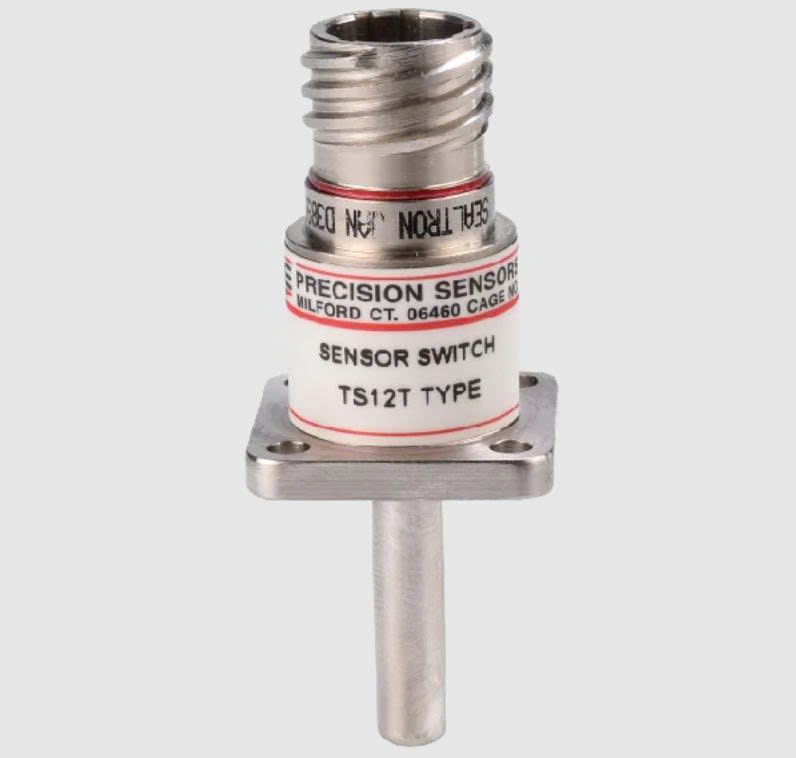
A Pressure Switch is an electromechanical device that detects when the pressure reaches a preset limit and activates or deactivates an electrical circuit accordingly.
For example, in a pneumatic or hydraulic system, a pressure switch can turn the pump on when pressure drops and turn it off when pressure reaches the desired value.
Key features of a Pressure Switch:
-
Mechanical design with high reliability and immunity to electrical noise.
-
Configurable or fixed setpoints for actuation.
-
Operates without external power supply for measurement.
-
Low hysteresis, ideal for simple ON/OFF control loops.
-
Extremely durable—can withstand vibration, shock, high temperature, or vacuum environments.
Example: The UE Series P12M-H Pressure Switch from Precision Sensors is built to MIL-SPEC standards, maintaining stable performance up to 400°F (≈200°C) even under severe vibration.
What Is a Pressure Transducer?
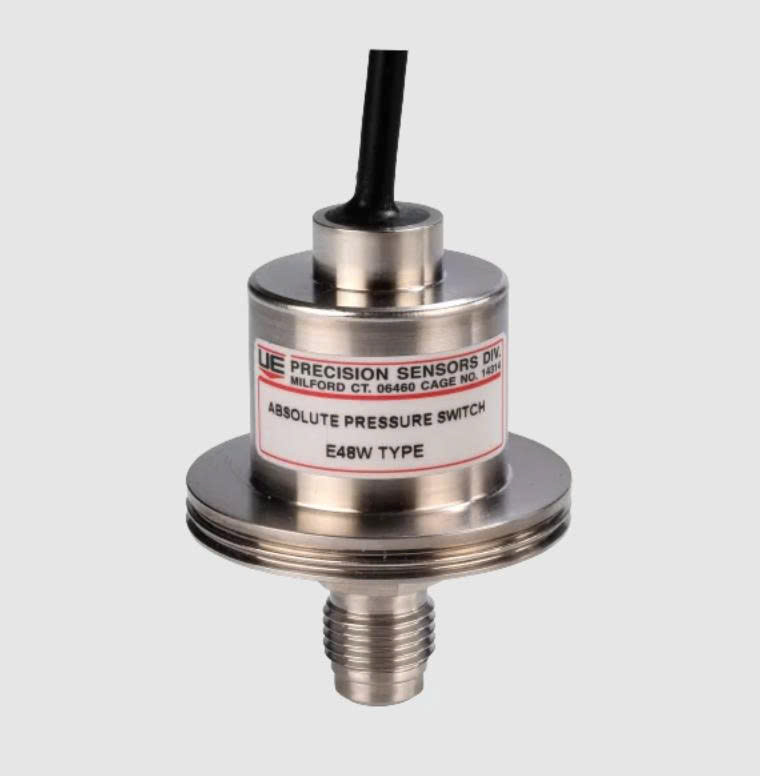
A Pressure Transducer (or Pressure Sensor) is a device that converts pressure into a continuous electrical signal, typically analog (0–5 V, 4–20 mA) or digital.
Unlike a switch, it doesn’t just detect thresholds—it measures the actual pressure value in real time for monitoring, recording, and control.
Key features of a Pressure Transducer:
-
High accuracy (often ±0.25% or better).
-
Provides continuous, real-time pressure readings.
-
Ideal for integration with PLC, SCADA, or automatic control systems.
-
Fast response time for dynamic process control.
-
Requires a stable power supply for operation.
Example: The UE XP Series Pressure Transducer delivers a linear output signal, ideal for monitoring vacuum levels, chemical reactors, or semiconductor production processes where precision is critical.
Pressure Switch vs. Pressure Transducer: Key Differences
| Criteria | Pressure Switch | Pressure Transducer |
|---|---|---|
| Operating Principle | Mechanical or electro-mechanical ON/OFF switching at set pressure | Converts pressure into a continuous electrical signal |
| Main Application | ON/OFF control, system protection, alarms | Continuous measurement, monitoring, and feedback control |
| Accuracy | Moderate (±1–2%) | High (±0.25% or better) |
| Output Signal | Mechanical relay or switch | Analog or digital signal |
| Power Requirement | Usually none | Requires power supply |
| Durability | Very high | Depends on environment |
| Cost | Low to medium | Higher |
| Typical Use Cases | Pumps, compressors, HVAC, hydraulic systems | Semiconductor tools, aerospace, chemical processes |
When to Choose a Pressure Switch
Choose a Pressure Switch if your system:
-
Only requires simple ON/OFF control (e.g., pump or alarm activation).
-
Operates in harsh or high-vibration environments where mechanical strength is critical.
-
Needs fail-safe protection that works independently of control systems or power supply.
Example: In aircraft or vacuum systems, UE pressure switches are used to shut down operations immediately when pressure exceeds safe limits, protecting both crew and equipment.
5️⃣ When to Choose a Pressure Transducer
Choose a Pressure Transducer if you need:
-
Continuous monitoring and data logging for process control.
-
Integration with PLC, DCS, or automated systems.
-
High precision and sensitivity, especially in semiconductor, chemical, or aerospace applications.
Example: In wafer fabrication, UE transducers monitor pressure differentials between vacuum chambers, ensuring nanometer-level process stability.
UE Precision Sensors Solutions
UE Precision Sensors provides both Pressure Switches and Pressure Transducers designed for extreme reliability in critical applications.
-
UE Pressure Switches are hermetically sealed, high-temperature capable, and MIL-STD certified.
-
UE Transducers are factory-calibrated for high precision and available with voltage, current, or digital outputs.
A key advantage of UE products lies in their customization flexibility—engineers can configure pressure ranges, body materials (Inconel, Stainless Steel), electrical interfaces, and certifications to fit specific requirements.
Conclusion
Pressure Switches and Pressure Transducers serve different but complementary roles in pressure management systems.
-
Pressure Switches are perfect for ON/OFF protection and simple control.
-
Pressure Transducers excel in precise, continuous monitoring and automated systems.
When selecting between them, consider:
-
Application goals,
-
Required accuracy,
-
Operating environment,
-
And budget.
For expert guidance or custom solutions, UE Precision Sensors—together with authorized distributors such as Sotaville—is ready to help you find the perfect sensor technology for your system.